7 Sept 2011

Robert Rauschenberg, 'Botanical Vaudaville' Inverleith House, Edinburgh

Robert Rauschenberg 'Eco-Echo IV', 1992-3 (detail)
courtesy Royal Botanic Garden Edinburgh/Gagosian Gallery.
Robert Rauschenberg is such an accessible and versatile artist, always surprising you with his juxtapositions of materials and ideas, questioning your thinking and approach to art and life. This show at Inverleith House, Edinburgh, is yet another example of quality curating in Scotland, especially after their Joan Mitchell exhibition. How great it would be to see such a show 'South of the Border' especially in London, can't believe it's the first show of his in the UK for 30 years, ho hum...Part of the press release for the show goes like this:  
'The American artist Jasper Johns (b.1935) once said of Robert Rauschenberg (1925-2008) that he had invented more than any artist since Picasso. Rauschenberg has altered the cultural landscape and continues to exert a profound influence on contemporary artists. Robert Rauschenberg 'Botanical Vaudeville' is the first museum exhibition devoted to the artist to take place in the UK in thirty years – and it features thirty seven works made between 1982 and 1998.
Robert Rauschenberg 'Tropical Mill Glut' 1989.
 courtesy Royal Botanic Garden Edinburgh/Gagosian Gallery
During this time, Rauschenberg was exploring the reflective, textural, sculptural and thematic effects of metal, glass and other reflective surfaces in several series of works. All are represented here, and the paintings and sculptures on display vary from the highly polished glamorous metallic works from the 'Shiner' and 'Borealis' series that celebrate energy and motion, to the Kabal American 'Zephyr' and 'Gluts' series which represent Rauschenberg’s; fascination with the discarded object.  He once stated: 'I think painting is more like the real world when it is made out of the real world. These works in particular benefit from being shown in natural light which is such a feature of exhibitions at Inverleith House, revealing their true colour - enhanced by multiple reflections of the viewer and garden which become part of the work.''

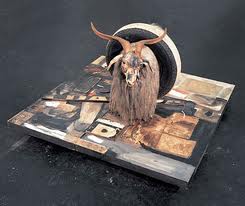
There are none of the big works like 'Monogram' (see below) or 'Bed' and the 'Combines', you have to go to Moma for them, however this looks like a an interesting exhibition because they are small, intimate and poetic works, in the way only Rauschenberg can make detritus look poetic..    Click below for that great interview where he discusses buying the goat for the 'Monogram' piece at the Guggenheim show back in the 1990's.

Robert Rauschenberg interview about 'Monogram' Guggenheim retrospective, 1990's

31 Aug 2011

A re-interpretation of Rodin and the figure, Rodin Museum, Paris


I love the Rodin Museum, but I must admit, I have'nt been for years..However, this is the last few days of a very interesting exhibition of works by a variety of artists entitled 'Work in Progress, Rodin and the Ambassadors' this exhibition is until 4th September.

Jean Arp, Marcel Duchamp, Joan Miro, Jean Fautrier, Lucio Fontana, Jean Dubuffet, Alberto Giacometti, Willem De Kooning, Joseph Beuys, Marcel Broodthaers, Eduardo Paolozzi, Anthony Caro, Cy Twombly, Eric Cameron, Richard Serra, Bruce Nauman, Haim Steinbach, Sophie Ristelhueber, Ugo Rondinone, Douglas Gordon, Urs Fischer...

Auguste Rodin, 'Etude de robe de chambre pour Balzac'
© Musée Rodin. Photo: Christian Baraja
'Works in Progress, Rodin and the Ambassadors' examines the way in which Rodin’s work is perceived and strives to show not only how his sculpture developed but also how it was and continues to be reinterpreted. The exhibition compares 100 or so works by Rodin (1840-1917) with about 30 post-1945, modern and contemporary works.'

Joseph Beuys, 'Infiltration homogène pour piano à queue; La Peau'
© Adagp, Paris 2011. Photo: CNAC/MNAM Dist.RMN
'This re-appraisal of Rodin’s work also owes something to art, eg. the production of several artists from the postwar period to the present day. Their preoccupations, not only with material and modelling but also with highlighting fragments or combining different components, have had repercussions on the manner in which Rodin is considered and contemporary art is viewed. From Marcel Duchamp (1887-1968) to Urs Fischer (born 1973), each of these artists has become an “ambassador” for a certain way of looking at the world, at art, at present and past works.'...

27 Aug 2011

Mondrian I I Nicholson: In Parrellel, Courtauld Gallery, London

Ben Nicholson, June, 1937

An exciting exhibition at the Courtauld Gallery, London, shall be taking place early next year (from February to May 2012), exploring the relationship between two enigmatic modernist abstract painters of the early 20th Century...

'The story of the creative relationship between the artists Piet Mondrian and Ben Nicholson is largely untold. Yet during the 1930s they were leading forces of avant-garde art in Europe.

This exhibition will be the first to offer a comprehensive account of the parallel artistic paths charted by Mondrian and Nicholson during this remarkable decade. It will bring together an extraordinary group of paintings and reliefs to show how each artist was driven by a profound belief in the potential of abstract art to attain the highest aesthetic and spiritual power.' 

I'll keep you posted of developments...

22 Aug 2011

Exhibition of early abstractions by Kandinsky at Guggenheim Museum, New York

Wassily Kandinsky, ‘Painting with White Border’, May 1913 and ‘Sketch I’ for ‘Painting with White Border' (Moscow) Guggenheim Museum’s conservation lab © 2011 Solomon R. Guggenheim Foundation

I am not a huge fan of Kandinsky, but I understand his significance as an artist and what he brought to early modernist thinking. This exhibition at the Guggenheim, New York, from 21st October until 15th January 2012 reunites the key early works Kandinsky painted. This particular painting above, entitled 'Painting with White Boarder', was completed nearly 100 years ago. Inspired by a trip the artist took to Moscow at the end of 1912. When he returned to Munich, hanging out with artists who would form 'Der Blaue Reiter' group and where he had been living intermittently since 1896, Kandinsky searched for a way to visually record the “extremely powerful impressions” of his native Russia that lingered in his memory. Over a period of five months, he explored various motifs and compositions in study after study, moving freely between pencil, pen and ink, watercolor, and oil. After he produced at least sixteen studies, Kandinsky finally arrived at the pictorial solution to the painting: the white border.


From the Guggenheim: 'This exhibition, co-organized with the Phillips Collection, Washington, D.C., will reunite for the first time the Guggenheim’s final version of the painting from May 1913 with twelve related drawings and watercolors and one major oil sketch and will feature the results of an extensive conservation study of the Guggenheim and Phillips paintings. This study revealed a previously unknown painting beneath the surface of the Phillips’s 'Sketch I' for 'Painting with White Border' (Moscow). A rare glimpse into Kandinsky’s creative process, this presentation reveals the gradual and deliberate way the artist sought to translate his ideas into a bold new language of abstraction.

Tracing Kandinsky’s working method through a roughly chronological display of twelve drawings and watercolors and one major oil sketch related to 'Painting with White Border'. According to a May 1913 essay Kandinsky wrote about the picture, later published in an album entitled Kandinsky 1901–1913 (1913), the artist executed the first oil sketch (owned by the Phillips Collection) “immediately upon my return from Moscow in December 1912.” The orientation of his preliminary studies evolved from a vertical to a horizontal format, and he used pencil, pen and ink, and watercolor throughout the many iterations.

Kandinsky explored key motifs reminiscent of his native Russia, including 'the troika' (a three-horse sled) and 'Saint George'. Ultimately the artist executed more studies than he had for any of his previous paintings before resolving the composition with a soft, undulating white border that he compared to a white wave. In his seminal 1911 treatise ('On the Spiritual in Art: And Painting in Particular'), Kandinsky wrote that the color white expresses a “harmony of silence. . .pregnant with possibilities.”

The conservation study supports interpretations of Kandinsky’s working method. For example, the direct application of the brush to canvas of 'Sketch I' implies a more spontaneous technique as compared to the more methodical treatment of the final work, 'Painting with White Border', in which Kandinsky used a graphite pencil to lay out compositional elements before painting. Studies of microscopic samples of paint from both works show that Kandinsky created his own palette out of combinations of as many as ten different pigments per hue.

The conservation team also discovered a previously unknown painting beneath the surface of 'Sketch I' for 'Painting with White Border' (Moscow). The underpainting, a representational landscape with figures, has been attributed to the German artist Gabriele Münter, Kandinsky’s companion from 1903 to 1916, based on its similarity to Münter’s gouache, Garden Concert on view in this exhibition, and a canvas on the same subject in a private collection. While there are few known instances of Kandinsky painting over an existing canvas and no other known instance of him painting over a work by Münter, limited study has been done of Kandinsky’s canvases to date. Future research and conservation analysis may better clarify the attribution of the underpainting.'

26 Jun 2011

Picasso painting 'Buste de Femme' in Palestine


For the first time a Picasso painting entitled 'Buste de Femme' from 1943 has come to Palestine to be shown at the International Art Academy. It's a cubist deconstruction of a woman's face, dominated in grey. This exhibition was two years in the making and is a very exciting opportunity to build a new cultural international cultural dialogue in the occupied territory of Ramallah in Palestine. The Picasso painting costs £4.5 million and is on loan from the Van Abbemuseum in Eindhoven. Only three people at a time will be able to see it to ensure the humidity, in the purpose-built viewing room, does not get damaged. 

Van Abbe museum's employees hang Pablo Picasso's "Buste de Femme" on a wall at the International Academy of Art Palestine in Ramallah.
What is also interesting is how Picasso can still stir the waters. Why does a Picasso, who died in 1973, still have such resonance in 2011? Also, perhaps art can play a more central role in difficult world zones where conflict has become the norm and cultural life is in limbo. Could we see other paintings being loaned from other prestigious galleries and what works would they be?..

At a cost of £50,000 in insurance and transport, the project began when Khaled Hourani, the director of the International Art Academy in Ramallah, visited the museum in 2008 and suggested a loan. "This started off as a crazy idea to bring a European masterpiece to a war-zone but I was only half-joking, " he said.

Detail of Picasso's, 'Buste de Femme' (1943) , oil-on-canvas work. Photograph: Peter Cox for the Guardian
From the Guardian Newspaper UK: "I want this to appeal to people like my mother and art students. Picasso remains inspirational because his work is related to war, peace and freedom."

Hourani hopes that 'Buste de Femme' will not be the last masterpiece to be exhibited in the territory. "We want this to become a normality but it is the last time I will do it. It has taken two years to bring one painting but the taboo has been broken and it will be easier for someone else to do it," he said. "The journey here adds meaning to the painting. It highlights issues of the freedom of movement and political agreement."

Read more on Van Abbemuseum here and AL Arabiya News

23 Jun 2011

Kurt Schwitters/MERZ updates, exhibitions and Merzbarn UK

I have always been influenced by the work of Schwitters, since my first few days at art school. In the UK his influence is everywhere, in fact it is hard to 'sweat it out' as Hoffman, once said about Cubism. In British art, it seems a default setting in fine art practice..this isn't necessarily a bad thing, but his influence runs deep. So I thought I'd put a post together of the diverse 'Schwitteresque' goings on out there.

It is the last few days of the 'Kurt Schwitters: Colour and Collage' exhibition at Princeton University Art Museum, New Jersey. This is an excellent exhibitions of small scale collage works and a recreation of the Merzbau, see below, runs until 26th June.

Kurt Schwitters, 'The Cherry Picture' 1921, hear an excellent audio guide from MOMA here.
'From now through, 2011, the Princeton University Art Museum this is the first survey of this pioneering artist's work in the United States since his retrospective at the Museum of Modern Art (MoMA) in 1985. The exhibition will provide an unparalleled opportunity to view Schwitters's experiments in depth, including a full-scale reconstruction of his groundbreaking Merzbau, which has never before been seen in this region.'

Born in Hannover, Germany, Schwitters (1887-1948) is one of the most influential artists from the interwar avant-garde. During a period of social and economic turmoil, he developed a unique practice, one that merged art and life, embraced disparate media and utilized found objects and printed materials, most of them the discarded remnants of everyday life. 'Kurt Schwitters: Color and Collage' was organized by the Menil Collection in Houston, see my earlier Schwitters post on this. It's about time, there was show like this in the UK.

A recording of Schwitters performing his phonetic poem (1922-32), will also be highlighted at the exhibition, Ursonate listen to a version by the artists himself here. 
 
There is a reconstruction of Schwitters's first Merzbau, destroyed by Allied bombs in 1943. In the UK,  there has been an extensive project to restore the Merzbarn, in  Elterwater, near Ambleside, in the Lake District. He was working on this before his death, see it here. Also there is Merzman, this an ongoing series of projects based in the UK that explores the infliuence of Schwitters, and is well worth looking at.

Kurt Schwitters, 'MZ 371' collage, 1922 (C) Menil Collection


Some background on Schwitters: In 1919, Schwitters named this body of work Merz-a neologism derived from the German kommerz (commerce)-which culminated in a series of collages, assemblages, experimental poems, prints and sculptures; the most famous being the Merzbau, a three-dimensional environment the artist began in the 1920s. Schwitters's work bridges some of the period's most important artistic movements, including Expressionism, Dada, Constructivism and Abstraction. Schwitters exerted a profound influence on artistic developments after World War II; Robert Rauschenberg and Jasper Johns, among others, considered him a source of inspiration, and contemporary installation art is inconceivable without the Merzbau. Schwitters was trained as a painter, and despite his experiments with other media, he never ceased painting. Indeed, painting informs almost all of his work, as witnessed by the passages of gouache, chalk, oils, paste and watercolor in his collages and assemblages-additions that transform the materials they cover. 

Merzbau Reconstruction, see Tate Research Papers here.

17 Jun 2011

'Cy Twombly & Nicholas Poussin: Arcadian Painters', Dulwich Picture Gallery, London

This is a great opportunity to consider the work of Cy Twombly with one of his hero's Poussin at the Dulwich Picture Gallery in South London from 29th June until 25th September.

Cy Twombly, 'Hero and Leander' (To Christopher Marlowe) Rome , 1985
This is a fascinating insight into the different approaches both artists have to their work with  over two centuries dividing them. Both artists have explored a sensibility to their work that retains a romanticism, mystic and enigmatic quality through the use of materials and paint.

'I would've liked to have been Poussin, if I'd had a choice, in another time.' Cy Twombly

Nicolas Poussin, 'Rinaldo and Armida', oil on canvas, c.1760
This exhibition will look at these two figures side by side for the first time, though they are separated by three centuries, the two artists nonetheless share remarkable similarities. The connections are highlighted through the key themes of Arcadia and the pastoral, Venus and Eros, anxiety and theatricality and mythological figures that are central to both artists' work.


As part of the exhibition, the Gallery is also extremely fortunate to have the opportunity to display Poussin's 'Sacrements' painted between 1637 and 1642 for his Roman friend and patron Cassiano dal Pozzo. As a set, Poussins 'Sacrements' represent a high point in Western European art.

A Conversation with Sir Nicholas Serota, July 19th 6-9PM
Sir Nicholas Serota, Director of Tate, talks to Dr Nicholas Cullinan, Curator of International Modern Art at Tate Modern and of the exhibition Twombly and Poussin 'Arcadian Painters' about his long involvement curating Cy Twombly’s work and the exhibition at Dulwich Picture Gallery.

Eva Rothschild at The Hepworth, Yorkshire

This is a powerful exhibition of an artist at the top of her game, Eva Rothschil, creates enigmatic three dimensional abstractions and is the first artist to be shown at the UK's new premier artspace in Yorkshire, The Hepworth... Celebrating the legacy of sculptor Barbara Hepworth.

Eva Rothschild, (c) The Hepworth, Wakefield
 ' 'Hot Touch' is a group of new and recent sculptures and photographs by Eva Rothschild. Her sculptures are made from a range of materials including fabric, leather and wood, bringing together the hand-made and the industrially produced. The works often combine the forms and strategies of modernist art; squares, triangles, holes and repetition, with an array of visual associations and symbols, such as totemic columns of piled heads and draped snakes.

This exploration of the power and meaning of objects produces an encounter between the minimal and the magical. Leaning against walls, suspended in mid-air, or balancing impossibly, Rothschild’s sculptures have an ambiguous and powerful presence, exploring universally recognised forms and symbols.'

The Hepworth, Wakefield, Yorkshire, England
The exhibition is accompanied by a new publication with an essay by Prof. Anne Wagner, author 'Mother Stone: The vitality of modern British Sculpture' (Yale University Press, 2005).

10 Jun 2011

Egon Schiele: 'Women' unseen paintings and drawings at Richard Nagy, London

Egon Schiele, painting on paper, gouache. c.1910. Richard Nagy Ltd.
Another powerful exhibition, not seen in London for some time, is currently on show at the Richard Nagy Gallery. Check out Jonathan Jones's article in the Guardian here, there are also more slides of the works on show. The work continues until 30th July.

For many, Schiele is still a controversial painter and his lifestyle still provocative. In my view, there are few painters from the twentieth century that are not controversial, from Schiele's contemporary Kilmt, to Picasso. Jonathan, states in his article: 

'There is a definite sense of discovering secrets, trespassing on hidden private lives, at the Schiele show,...The exhibition collects nearly 50 masterpieces – fragile works on paper – that dealer Richard Nagy has sold throughout his career and has borrowed back from private collectors to mount one of the most spectacular Schiele shows ever seen in the UK.'

This exhibition exhibits drawings on paper in watercolour and gouache. He creates poses that are intimate and yet for public consumption, many of these poses reflect the wider feelings explored by German Expressionism and New Objectivity movements across Germany and Europe in the 1920's and 30's. In my ways he predicted the voyeuristic desire that is so prevalent in society since WWI. He died at 28 of influenza in 1918. There are some self-portraits in the exhibition, including the infamous 'Eros'...
Egon Schiele, Reclining Female Nude with Violet Stockings, 1910. Gouache, watercolour and black crayon on paper, 31.6 x 44.9 cm (12 ½ x 17 5/8 in). Private Collection, Courtesy of Richard Nagy Ltd, London.

4 Jun 2011

Picasso, Miro, Dali-Angry Young Men: The Birth of Modernity

This is a fascinating exhibition on the relationships between the Picasso, Dali and Miro, currently exhibited at the Foundation Palazzo Strozzi, Florence, Italy until 17th July. This exhibition documents the influences each artist had on each other, the wider painting scene in Spain, and in turn, the legacy they left on the culture of the early Twentieth Century and the development of modernism. What is also interesting about this exhibition is how the strong political convictions are explored especially with regard to the early Picasso and Miro pieces, many not exhibited before. there is also some strong abstract, semi-abstract works by both artists. There is a walk through each room here. The show is curated by Eugenio Carmona, Christoph Vitali.

Pablo Picasso 'Harlequin and his Girlfriend' 1901, Pushkin Museum
'The exhibition is dedicated to the early work of Picasso, Miró and Dalí, which played a decisive role in the beginning of modern art in Spain. The exhibition concentrates on Picasso's pre-cubist period 1900 - 1905, whilst Juan Miró's works of 1915-1920 are presented along with Salvador Dali's from 1920-1925, both artists painting in the period before the discovery of surrealism. Each artist will be represented by 25 - 30 masterpieces selected to show aspects of the three artists in their earliest periods, works that are rarely shown in mainstream catalogues and exhibitions. For instance, Picasso's early work was often coloured by his strong political convictions.

Joan Miro 'Poem Painting' c.1925
In Madrid in 1901, Picasso and his anarchist friend Francisco de Asís Soler founded the magazine Arte Joven (Young Art), which published five issues. Picasso illustrated the journal, mostly contributing grim cartoons depicting and sympathizing with the state of the poor. Miró too understood art as political, and Miró's oft-quoted assassination of painting is derived from a dislike of bourgeois art of any kind, especially when used as a way to promote cultural identity among the wealthy. Specifically, Miró saw Cubism in this way, and he is quoted as saying I will break their guitars, referring to Picasso and Braque's early Cubist paintings. Much younger than Picasso and Miró, Dalí was expelled from the Academia in 1926 shortly before his final exams when he stated that no one on the faculty was competent enough to examine him. His mastery of painting skills is well documented in his early works, such as the flawlessly realistic Girl at the window, which was painted in 1926. That same year he made his first visit to Paris where he met with Pablo Picasso, whom young Dalí revered - Picasso had already heard favourable things about Dalí from Joan Miró.'


1 Jun 2011

'Zig Zag: Deliberations on construction, sequence and colour' @ Charlie Dutton Gallery, London


This is an innovative and diverse exhibition of new developments in abstraction. The exhibition which is opening this week at Charlie Dutton Gallery (Holborn Tube) Princeton Street, London from this Friday (Private View) 9th June-2nd July, 2011.


These artists have developed an understanding for the possibility of an ‘internal logic’ in their work; an idea which artists such as Mary and Kenneth Martin talked about in their teaching in the 1950s, as well as explore ideas of ‘colour interaction’ and ‘colour juxtaposition’. 

Isha Bohling


'In her essay, ‘The Writings of Mary Martin’ 1990, Hilary Lane discusses Mary Martin’s idea that all ‘words’ or information needed to describe the artworks should be embedded in the work itself; that written language cannot always express or explain the processes and decisions made during their construction. Mary Martin wanted the story of how her work was made to be clear to the person when looking at it. And although proportion, rhythm and measurement were key she wanted to emphasise the unexpected and a need to remain inventive. Of the process of construction itself Martin wrote that it is: ‘a thinking making process, not necessarily in three dimensions. Internal logic is the key. The success of such a process is wholly dependent on a right choice of symbols. The choice is based on intuition and experience.’

Jost Munster, similar works in 'Zig Zag'
The work in this show examines how artists are still discovering new visual ideas, through the complex and technically challenging process of applying paint and other materials onto a ‘blank canvas’. It is hoped that through the process of contrasting and comparing an opportunity is provided for debate and discussion with regard to visual language: a small critical forum for artists and audience to consider these works and the concepts, methods or systems behind their construction.'


Otto Dix at the Institute of Foreign Affairs Gallery, Berlin

There is an interesting exhibition of the works of Otto Dix, the fascinating German artist who worked in both Expressionism and Dada at the Institute of Foreign Affairs Gallery in Berlin, Germany. The exhibition Otto Dix : Social Criticism Prints 1920-1924, 'Der Kreig (war) Etching Set 1924 runs until 7th August.

Otto Dix, etching, circa 1920
'With more than 600 drawings from the years 1914 to 1918 were done at various theatre's of war in Belgium, France and Russia, in the course of his military service. These protocols of war, created on the spot and of high artistic value, together with his own memories of the horrors of World War I, also formed the basis of a later grandiose serial work entitled "The War", published in 1924 by Karl Nierendorf in Berlin.

The cycle, consisting of fifty separate drawings and often compared to Goya's 'Desastres de la Guerra', (Disasters of War) does not only give an authentic and horrifying portrayal of the terrible trench fighting that took place in the great battles of this first world war-it also unmasks the 'moloch' of war for what it truly is. This series of etchings, which ranks particularly highly among the main works of Dix's oeuvre, forms the center of attention of this exhibition. 

Otto Dix, etching, c.1920
Dix never imagined that he could change people, i.e. humanity as such, by means of his works. But for these works, paintings and prints against war, he drew the rage and the hate, up to and including defamation, of the Nazi regime, which, after coming to power in 1933, removed him from his chair, as one of the first Academy professors to suffer this, and forbade him to exhibit.

The truth was important for Dix, also in his focus upon marginalized social groups of the postwar era, such as war veterans who had lost limbs, etc. and prostitutes; the collection included in this exhibition shows characteristic examples of such unfortunates. This inexorable drive to show the truth was already a source of agitation and protest among his contemporaries before the Nazis were in power. 

'I will either be famous or infamous', he once said as a young man. He has become both.'

Abstraction: Thomas Muller @ Fruehsorge|contemporary drawings, Berlin

Thomas Müller, 'Untitled' 2010, pencil chalk and ink on handmade paper, 160 x 115 cm
It's the last couple of days of Thomas Müller at Fruehsorge | contemporary drawings, Heidestrasse, Berlin, next to the contemporary art museum Hamburger Bahnhof.  This exhibition will run until 3rd June 2011. 

Muller is an artist who works in abstraction and only uses the medium of drawing, and I can't think of a better place for an exhibition than the Fruehsorge. He has shown at the New York Drawing Centre and in the exhibition “Linea, Linie, Line” at the Institute for Foreign Cultural Relations extensive drawing overview in Bonn. His work is also present among numerous German and international collections such as Kunsthalle Hamburg, Pinakothek der Moderne München, the Kupferstichkabinett Berlin and the Centre Pompidou in Paris, France. In 2010 Müller was nominated for the Fondation Guerlain’s renowned “Prix de dessin contemporain”.

Müller's work explores 'the substance and nature of drawing and the drawing process itself, which materializes as a stroke or trace on the page and means the line doesn’t depict nor describe but becomes the subject matter itself.' What is also interesting is the use of such diverse materials such as chalk, ink, oils, acrylics, ballpoint pen, colour and led pencil and yet he retains a coolness to the final image in that he doesn't make that use of the materials the main thing about it. He explored the space of the picture plain with minimal markings in a rythmn of interwoven grids and wave-like structures, that have a zen like quality. Gorgeous..

17 May 2011

‘A Sort of Night to the Mind, A KIND OF NIGHT FOR OUR THOUGHTS’ exhibition @ Arch 402 Gallery, London

This is an interesting mixed show of contemporary painters in London at the Arch 402 Gallery, some abstract, some semi-abstract, figurative and cross-disciplinary. This is showing until 10 June, 2011 (gallery hours: Wed-Fri 11-6, Sat-Sun 11-3 PM).
Roger Kelly, 'Separator' 2011
Phillip Allen,  Edwin Aitken,  Andrew Bick,  Simon Burton,  Varda Caivano,  Leigh Clarke,  Nigel Cooke,  Moyra Derby,  Pamela Golden,  Mark Hampson,  Beth Harland,  Mark Harris,  Vincent Hawkins,  Claude Heath,  Paul Housley,  Roger Kelly,  Bob Matthews,  Andrea Medjesi-Jones,  Jost Münster,  Martina Schmid,  Joel Tomlin,  Phoebe Unwin,  Julian Wakelin

'A Sort of Night to the Mind, A KIND OF NIGHT FOR OUR THOUGHTS', an exhibition of twenty-three UK based artists engaged with painting. Curated by Moyra Derby and Bob Matthews, the exhibition will also host a series of talks and educational events led by some of the featured artists.
 
Two alternative translations of
Honoré de Balzac’s description of illusion from the 1832 short story ‘The Purse’ provide the title for this exhibition. First shown at The Herbert Read Gallery  at the University for the Creative Arts in Canterbury, ‘A Sort of Night to the Mind, A KIND OF NIGHT FOR OUR THOUGHTS’ demonstrates the recurring relevance of illusion and in counterpoint, materiality. Illusion and materiality can be argued as so inevitable in the context of painting as to hardly warrant remark, but at the same time they muster such historically resonant responses and strength of feeling that they can feel like a prompt to take sides. However it is an interest in the productive play between these two qualities of a marked surface that has brought this group of works together, an acknowledgment of the imaginative potential of oppositions; “In the half light the physical tricks used by art to make things seem real disappear completely.... At that hour illusion reigns supreme; perhaps it comes with the night? Is not illusion a kind of night for our thoughts, a night which we furnish with dreams.'

Andrew Bick, oil on canvas, 2010

16 May 2011

A few thoughts on abstraction/political art and 'Joan Miro: The Ladder of Escape' exhibition, Tate Modern, London

We shouldn't underestimate the significance of Joan Miro, currently on show at Tate Modern, 'Joan Miro: The Ladder of Escape'. We can see the 20th Century unfold through his work, about 150 works on show, from early Fauvist pieces, through Cubism and into Surrealism. By the 1960's he was responding to the developments in abstraction taking place in both Europe and America. I wonder if we'd have CoBrA, Dubuffet, Tapies, the playfulness of Arte Povera and many other movements that have the same 'naivety' yet retain a strong political presence, if not for the likes of Miro. This work entitled 'Fireworks, I,II,II' is a great triptych about space and spontaneity, from a man in his eighties with fire in his belly.

Joan Miro 'Fireworks, I,II,III' oil on canvas, 1974 (c) Artobserved
Parallels to Robert Motherwell and especially his 'Elegy to the Spanish Republic' as well as his 'Zen' lithographs abound here, they almost echo each other across the Atlantic. Many of the critics in the British press have focused on the early Miro works as the most significant, but I think the curators (see BBC interview with Matthew Gale here and Marko Daniel) have done well in bringing a sympathetic understanding to the late works, showing his experimental and versatile approach to his art-making in the last few rooms of the exhibition.

Robert Motherwell 'Elegy to the Spanish Republic' oil on canvas, 1961. (c) Metropolitan Museum
Most poignant was the last painting in Room 13, entitled 'Tete' (Head) (I unfortunately can't find an image for it). It was a painting started in the 1940's and finished in 1974. It is a black, dark mass with one red beady eye in the centre and a hand in the top left, is it waving or drowning? It has a subtle power suggesting imprisonment, it reminds me of Paul Klee's 'Captive' or 'Embrace' from 1939, that echo a different oppressive era. This is where the strength of Miro lies, in his emotional and political sensibilities with paint as his tool. 

Paul Klee 'Embrace' oil on paper, 1939


Downstairs we passed through the Turbine Hall and saw what remains of Ai Weiwei's 'Sunflower Seeds' being demounted and bagged up. There were signs reminding the public of his subsequent arrest and I thought how apt that last Miro painting of show was, but also how powerful abstraction in painting can be in such difficult times.

'I understand that an artist is someone who, in the midst of others' silence, uses his own voice to say something and who makes sure that what he says is not useless, but something that is useful to mankind.' Joan Miro


Ai Weiwei's bagged up 'Sunflower seeds', Turbine Hall, Tate Modern (c) David Moxon


7 Mar 2011

Gillian Ayres exhibition at Arnolfini, Bristol

May 12 -3 July 2011

There is to be a new exhibition of the artist Gillain Ayres at Arnolfini, Bristol. She was considered one of the most important British painters working in abstraction in the post-war period. Particularly noted for her wide variety of mark-making styles and use of rhythm and colour. Ayres exhibited at Arnolfini during its early days, and her painting 'Break-Off', 1961, painted the year Arnolfini was established, has been selected for this exhibition by Annabel Rees, co-founder of Arnolfini especially for our 50th anniversary programme. Break-off is presented alongside a new work that Ayres painted this year. 

Gillian Ayres 'Break Off', Oil on Canvas, 1961 (c) Tate Gallery
See more of her paintings at the Alan Cristea Gallery