Showing posts with label Modern British art. Show all posts

7 Mar 2011

Gillian Ayres exhibition at Arnolfini, Bristol

May 12 -3 July 2011

There is to be a new exhibition of the artist Gillain Ayres at Arnolfini, Bristol. She was considered one of the most important British painters working in abstraction in the post-war period. Particularly noted for her wide variety of mark-making styles and use of rhythm and colour. Ayres exhibited at Arnolfini during its early days, and her painting 'Break-Off', 1961, painted the year Arnolfini was established, has been selected for this exhibition by Annabel Rees, co-founder of Arnolfini especially for our 50th anniversary programme. Break-off is presented alongside a new work that Ayres painted this year. 

Gillian Ayres 'Break Off', Oil on Canvas, 1961 (c) Tate Gallery
See more of her paintings at the Alan Cristea Gallery

8 Jan 2011

Modern British Art in 'Restless Times: Art in Britain 1914-1945'


This is an excellent exhibition of British art on show at the Millennium Gallery in Sheffield until 30th January. It explores the social impact of WWI on the wider society but also how modern art was attempting to break out of the the very conventional visual culture that existed between the wars. This exhibitions shows us through the sculptures and drawings of Henry Moore, the geometric abstract paintings of David Bomberg in his painting 'In The Hold', the famous 'Bird Swallowing a Fish' sculpture by Henri Gaudier Brzeska, and many others, how powerful these works remain nearly a century later.

David Bomberg, 'In the Hold' (c) Tate, London


We must remember how British modern art is a complicated response to our wider connection with the world. On one hand Europe and the other America. We have never totally embraced 'Modernism' as warmly as our European friends did in these intervening decades, we had to somehow 'translate' modernism into our own identity. Hence we have a fusion of styles and processes, from landscapes, figuration and social commentary, through semi-abstraction, a Surreal form of Realism (see below Evelyn Dunbar's, 'A Land Girl and the Bail Bull' 1945) and a strange form of 'British' Cubism that became our form of Abstraction. All these styles never seem to coalesce as a body of work, in the way our French or German counterparts do and yet through exhibitions like this one, we come to understand that this is the beauty of modern twentieth century British art, it is eccentric and eclectic, yet it's honest and innovative.

 
Evelyn Dunbar, A Land Girl and the Bail Bull, 1945 © Tate, London 2010


From the devastating impact of war and a retreat from the harsh realities of life, to the celebration of the pastoral idyll and the embracing of new ideas and technologies, the exhibition examines how artists engaged with both the uncertainties and possibilities of the time. 
We are, some hundred years later, beginning to appreciate our approach to modernity through our modern art, and for that reason this type of exhibition would have travelled well around the country. The Tate and its Great British Art Debate and the Millenium Gallery as well as other regional collections that have lent work, have done well in curating such an interesting and educational exhibition.

Clive Branson, 'Bombed Women and Searchlights' 1940 © The Estate of Clive Branson / Tate, London 2010


'Restless Times' brings together over 150 significant works drawn from national and regional collections including Tate, Norfolk Museums and Archaeology Service, Tyne & Wear Archives & Museums and Museums Sheffield. other works on display are: Cyril Power, 'The Tube Station' (1932), CRW Nevinson, 'Twentieth Century', John Nash, 'The Cornfield' (1918), William Roberts, 'The Cinema' (1920), Clive Branson, 'Selling the 'Daily Worker' outside Projectile Engineering Works' (1937), Barbara Hepworth, 'Mother and Child' (1934), Henry Moore, 'Shadowy Shelter' (1940) and Ceri Richards, 'Blossoms' (1940). The exhibition will also include a number of contemporary works including a new commission by Hew Locke.

Again, it is a shame this exhibition is not touring across the country...

5 Nov 2010

Patrick Heron by Janet Street-Porter on The Genius of British Art: Modern Times, C4

It was great to see the broadcaster, Janet Street-Porter on The Genius of British Art on Channel 4, discuss how she came to understand modern art, meeting Heron's daughter Katherine Heron when studying architecture. There is a great moment on the programme where they cut between him in his studio at Porthmeor Studios, he died in 1999, probably in the early 1980's and her stitting there now some 30 years later remembering when she would sit and talk with him about art and watch him painting, it was really quite touching..

Yellow Painting: October 1958 May/June 1959  Oil on canvas, 1524 x 2138 x 30 mm
 Purchased with asistance from Tate Friends St Ives 1999 (c) Estate Patrick Heron

Janet Street-Porter and Katherine Heron discuss this painting which has to be one of his most significant works, I believe this is in Tate Modern or Tate St.Ives... 

 
In the programme she went on to argue how Heron's work of that time was such an antidote to the the dull post war paintings of Lowry and Bratby. My frustration is that we have not understood that British abstraction and especially the 'St.Ives School' have never had the recognition for its significance, when considering how little was taking place in London at the time, which was 'kitchen sink' and a dull form of British (English?) expressionism. Street -Porter goes on to say how Heron's abstractions said 'bollocks to complancy'. It was a great little bit of British televison...

7 Oct 2010

'Throwing Shapes' @ Coleman Project Space and Cafe Gallery, London

7 October - 7 November 2010

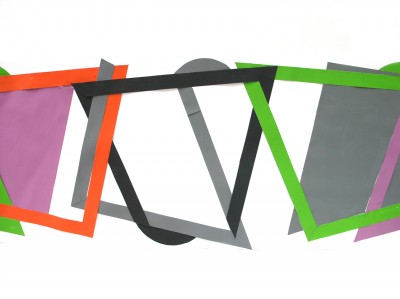
This is an interesting exhibition of a group of diverse artists working with abstraction in London. Defining 'hard-edge' abstraction in its diverse forms from installation to raw canvas. Here's the blurb, not sure how much I believe... Coleman Project Space presents a two-venue initiative curated by Rebecca Geldard with Vanessa Jackson, Clare Goodwin, Alasdair Duncan and Kilian Rüthemann.

'Jan & Dan', Claire Goodwin, 68 cm x 50 cm, Medium: Mixed media, Catalogue No: CGP1259

'Throwing Shapes' is a group exhibition on the itinerant nature of abstract painting’s core motifs. The conversational starting point for this colourful dialogue between venues, and works in various media, is a large-scale wall-painting commission by Vanessa Jackson at CGP London’s Cafe Gallery.
While the title elicits the notion of sharply defined forms flung, or Modernist-indebted visual strategies, it also references dance and music. ‘Throwing shapes’, like the term ‘abstract’ for an art context, has become a generic expression. It is now synonymous with human movement to music/sounds of all kinds but was initially used to describe the repetitive physical actions associated with electronic dance music: a simple sign language for those under its influence.


  • Vanessa Jackson, Dimensions not supplied, Medium: Installation, Catalogue No: CGP1248
This sense of reduction and recycling of forms and trends - given the recent nu-rave revival traceable through music, art and fashion, for example - is key to the exhibition remit. 'Throwing Shapes' does not attempt to survey the new, however, or plot fixable paths between the past and present, rather identify some curious conceptual territories emerging from artists’ re-negotiation of these basic forms; locate points at which specific aesthetic languages shift, mutate or break down.

Alasdair Duncan’s “signs for the future” pitch the viewer between the language of propaganda, painting and the perfunctory signage of everyday life. The London-based artist’s colour-rich, optimistic motifs, borrowed equally from the Bauhaus as the Highway Code, will appear here in two site-specific vinyl and sculptural works at Coleman Project Space.

Zürich-based Clare Goodwin also mines the past in a strangely positive way, her human-titled paintings conveying both the gritty reality of an era and sense of nostalgia one can have for a time that is not their own. Seventies design graphics and Op-art strategies appear rudely cropped into seductively hard-edged, conceptually adulterous compositional unions.

It makes perfect sense that Vanessa Jackson’s ritual play on canvas with geometric systems should find its way onto public surfaces given her interest in the democracy of mathematical approaches to art. Where Jackson’s ambitious three-floor mural for Sadler’s Wells in 2008 provided a lyrical framework for the performative dimension of the site, here the big white box of CGP London will become test-cell for the optical and kinetic possibilities of forms placed “arm-in-arm, hip-to-hip” in space. 

Swiss artist Kilian Rüthemann is known for his minimal, mostly temporary sculptural alterations to architectural spaces. For this, Rüthemann’s first London exhibition, the Basel-based artist will show a film in Coleman Project Space’s acclaimed Shed Space. Here, the virtual realm of the computer program provides the contextual fabric for his study of line and form as dictated by the flight paths of birds at sunset.

Times: Thursday - Sunday from 12 - 5pm.

19 Oct 2009

A Good Read For Winter Evenings..


Irving Sandler, A memoir: A Sweeper Up After Artists, 2008

Old Skool Painting:
I am currently reading this book, a light trawl through the New York art scene of the 1950's and 60's. Great annecdotes on conversations at the Cedar Tavern and the 'Club'. Some artists made the journey, others got lost along the way...(and not bad for a fiver!) This is an interesting article discussing these times by Peter Plagens.

This is another book I found interesting:

Groovy Bob: The Life and Times of Robert Fraser by Harriet Vyner

It's an intriguing book about the life of Robert Fraser, the art dealer, immortilized by Richard Hamilton on the cover, handcuffed to Mick Jagger in the back of the police car being taken them to court...
This is a sad yet hilarious account of Swinging London in the Sixties and how Robert Fraser made the careers of Peter Blake, Richard Hamilton, Bridget Riley, Jim Dine etc, great quotes from Jagger, McCartney and others such as Dennis Hopper, Kenneth Anger and Keef on the wider art, music and drugs scene at the time.

Both these books are documenting the social history you don't get in art history books...