21 Nov 2010

Kurt Schwitter's: Still crazy after all these years...

It is remarkable to see how influential Kurt Schwitters remains in the 21st Century. There are a number of contemporary exhibitions on the work of one of the 20th Century's most remarkable artists. He has influenced British art, and especially abstraction, a great deal.

Kurt Schwitters, Untitled, (c) The Menil Collection, Houston, USA
Schwitters, who helped to define avant-garde art through his work with German Dada in Hanover, (after a falling out with the Berlin Dadaists), brought Dada practices to a wider audience through his 'merz' constructions of collage, photo-montage and found objects, such as tram tickets, newspaper adverts and fashion illustrations. Also he created three domensional constructions, his most famous being known as the 'Merzbau' or 'The Cathedral of Erotique Misery' (see below). He also developed innovative experimental typographic design through his 'Merz' publications with the Constructivist El Lizzitsky and Theo van Doesburg of De Stijl. 

Kurt Schwitters performing his 'Urlauten',/'Ursonate' c.1920's
The 'Ursonate', his phonetic sound poem from 1922–32 (a translation of the title is 'Primeval Sonata'), is still seen as an unusual and evocative performance piece, still performed around the world. Perhaps we have understood the influence of Schwitters more through the artists who have been influenced by him after WWII, such as Robert Rauschenberg, Jasper Johns, Cy Twombly, Ed Ruscha, Damien Hirst, amongst many others.

Their are two shows/explorations currently exhibiting his work:

Exhibitioin in USA:
The Menil Collection, Houston, Texas, (the great American collection of modern art), this exhibition explores Schwitters use of colour and light in his work on both paintings and collage. Kurt Schwitters: Color and Collage, is until 30th January 2011 and its emphasis is on the Merz works from the 1920s and 1940s. 
Kurt Schwitters, 'For Kate',1947
This is the first show of Schwitter's works since the 1985 exhibition at MOMA. The exhibition will travel the US to Princeton University Art Museum March 26–June 26, 2011, followed by Berkeley Art Museum, Pacific Film Archive from August 3–November 27, 2011. 

Exhibition in the United Kingdom:
The other exhibition or perhaps exploration and celebration of his work is the British organisation that has been set up to archive and preserve his little known works in Britain, where he was eventually interned and died in Ambleside, Cumbria. One of his last Merzbau's is celebrated on the website: http://www.merzbarn.net. This construction made in a remote barn in the Langdale Valley and was created during his stay in the Lake District, yet financed by MOMA in New York, is now preserved at the Hatton Gallery, University of Newcastle by the artist Richard Hamilton in 1965. You can see the documented reconstructions in 2007, of his Hanover Merzbau here from the Tate archive. This is a great organisation celebrating his art, preserving his legacy and raising funds for the upkeep of his last remaining Merbau. Schwitters died in 1948. Kurt Schwitters still crazy after all these years....


Kurt Schwitters,'The Cathedral of Erotique Misery', Hanover, Germany


Kurt Schwitters, 'Merzbarn', Cumbria UK

5 Nov 2010

Patrick Heron by Janet Street-Porter on The Genius of British Art: Modern Times, C4

It was great to see the broadcaster, Janet Street-Porter on The Genius of British Art on Channel 4, discuss how she came to understand modern art, meeting Heron's daughter Katherine Heron when studying architecture. There is a great moment on the programme where they cut between him in his studio at Porthmeor Studios, he died in 1999, probably in the early 1980's and her stitting there now some 30 years later remembering when she would sit and talk with him about art and watch him painting, it was really quite touching..

Yellow Painting: October 1958 May/June 1959  Oil on canvas, 1524 x 2138 x 30 mm
 Purchased with asistance from Tate Friends St Ives 1999 (c) Estate Patrick Heron

Janet Street-Porter and Katherine Heron discuss this painting which has to be one of his most significant works, I believe this is in Tate Modern or Tate St.Ives... 

 
In the programme she went on to argue how Heron's work of that time was such an antidote to the the dull post war paintings of Lowry and Bratby. My frustration is that we have not understood that British abstraction and especially the 'St.Ives School' have never had the recognition for its significance, when considering how little was taking place in London at the time, which was 'kitchen sink' and a dull form of British (English?) expressionism. Street -Porter goes on to say how Heron's abstractions said 'bollocks to complancy'. It was a great little bit of British televison...

29 Oct 2010

Painting against Mussolini: Art and the Fall of a Dictator, Estorick Collection of Modern Italian Art, London

Estorick Collection of Modern Italian Art in London, from 22nd September - 19th December 2010

these dark painting from Mafai and Garelli are worth seeing. we are often more aware of the painting from this period of Max Beckmann and other New Objectivity paintings that stood against Fascism than Italian painting from that time. They should be appreciated more and still retain much of the original power all these years later worth a trip to North London...

Mario Mafai, Fantasia - Interrogation, 1941-43


                                                           Franco Garelli, Shooting, c. 1944

27 Oct 2010

Floris Neususs 'Nudo-grams' @ Shadow Catchers exhibition, V&A Museum, London


This is a fascinating exhibition exploring the concept of shadows through a varirty of approaches. well worth looking at, it is a cross between 19th Century ideas in science and technology with a radical 20th Century experimental idea of art-making. this would be a good companion exhibition to the Eadweard Muybridge at the Tate in London.

Floris Neusüss

Born Lennep (Germany), 1937. Floris Neusüss has dedicated his whole career to extending the practice, study and teaching of the photogram. Alongside his work as an artist, he is known as an influential writer and teacher on camera-less photography.

Neusüss brought renewed ambition to the photogram process, in both scale and visual treatment, with the Körperfotogramms (or whole-body photograms) that he first exhibited in the 1960s. Since that time, he has consistently explored the photogram's numerous technical, conceptual and visual possibilities.

His works often deal in opposites: black and white, shadow and light, movement and stillness, presence and absence, and in the translation of three dimensions into two. By removing objects from their physical context, Neusüss encourages the viewer to contemplate the essence of form. He creates a feeling of surreal detachment, a sense of disengagement from time and the physical world. Collectively, his images explore themes of mythology, history, nature and the subconscious.

7 Oct 2010

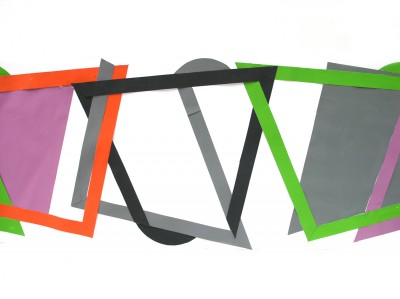
'Throwing Shapes' @ Coleman Project Space and Cafe Gallery, London

7 October - 7 November 2010

This is an interesting exhibition of a group of diverse artists working with abstraction in London. Defining 'hard-edge' abstraction in its diverse forms from installation to raw canvas. Here's the blurb, not sure how much I believe... Coleman Project Space presents a two-venue initiative curated by Rebecca Geldard with Vanessa Jackson, Clare Goodwin, Alasdair Duncan and Kilian Rüthemann.

'Jan & Dan', Claire Goodwin, 68 cm x 50 cm, Medium: Mixed media, Catalogue No: CGP1259

'Throwing Shapes' is a group exhibition on the itinerant nature of abstract painting’s core motifs. The conversational starting point for this colourful dialogue between venues, and works in various media, is a large-scale wall-painting commission by Vanessa Jackson at CGP London’s Cafe Gallery.
While the title elicits the notion of sharply defined forms flung, or Modernist-indebted visual strategies, it also references dance and music. ‘Throwing shapes’, like the term ‘abstract’ for an art context, has become a generic expression. It is now synonymous with human movement to music/sounds of all kinds but was initially used to describe the repetitive physical actions associated with electronic dance music: a simple sign language for those under its influence.


  • Vanessa Jackson, Dimensions not supplied, Medium: Installation, Catalogue No: CGP1248
This sense of reduction and recycling of forms and trends - given the recent nu-rave revival traceable through music, art and fashion, for example - is key to the exhibition remit. 'Throwing Shapes' does not attempt to survey the new, however, or plot fixable paths between the past and present, rather identify some curious conceptual territories emerging from artists’ re-negotiation of these basic forms; locate points at which specific aesthetic languages shift, mutate or break down.

Alasdair Duncan’s “signs for the future” pitch the viewer between the language of propaganda, painting and the perfunctory signage of everyday life. The London-based artist’s colour-rich, optimistic motifs, borrowed equally from the Bauhaus as the Highway Code, will appear here in two site-specific vinyl and sculptural works at Coleman Project Space.

Zürich-based Clare Goodwin also mines the past in a strangely positive way, her human-titled paintings conveying both the gritty reality of an era and sense of nostalgia one can have for a time that is not their own. Seventies design graphics and Op-art strategies appear rudely cropped into seductively hard-edged, conceptually adulterous compositional unions.

It makes perfect sense that Vanessa Jackson’s ritual play on canvas with geometric systems should find its way onto public surfaces given her interest in the democracy of mathematical approaches to art. Where Jackson’s ambitious three-floor mural for Sadler’s Wells in 2008 provided a lyrical framework for the performative dimension of the site, here the big white box of CGP London will become test-cell for the optical and kinetic possibilities of forms placed “arm-in-arm, hip-to-hip” in space. 

Swiss artist Kilian Rüthemann is known for his minimal, mostly temporary sculptural alterations to architectural spaces. For this, Rüthemann’s first London exhibition, the Basel-based artist will show a film in Coleman Project Space’s acclaimed Shed Space. Here, the virtual realm of the computer program provides the contextual fabric for his study of line and form as dictated by the flight paths of birds at sunset.

Times: Thursday - Sunday from 12 - 5pm.

5 Oct 2010

Gerhard Richter at New Walk Art Gallery, Leicester

Gerhard Richter, Abstract Painting, 1994, 225 cm x 200 cm,
Oil on canvas, Catalogue Raisonné: 809-3 © Gerhard Richter 2010.

Any excuse to see a Richter show in the UK. Here is an interesting exhibition in Leicester. Have a read of the press release below:

ARTIST ROOMS
Epoch - 
Gerhard Richter
2nd October 2010 - 27th February 2011
New Walk Museum & Art Gallery
(In partnership with The City Gallery)

'The German artist Gerhard Richter is considered to be one of the most important living painters in the world. Over a career spanning more than half a century, Richter has exhibited work in every major gallery in the world from The Museum of Modern Art in New York to Tate Modern in London. His influence on the next generation of artists such as Damien Hirst has been enormous.

Much of his work has been an exploration of the ways in which photography has changed the nature of painting over the twentieth century. In some of his first paintings to become famous he created ‘photo-realistic’ images that reproduced the blurring of photographs.

This exhibition, entitled Epoch, is taken from ARTIST ROOMS, a new national collection established by the dealer and collector Anthony d’Offay, jointly owned by Tate and the National Galleries of Scotland. The exhibition also includes a selection of the artist’s multiples, lent by Anthony d’Offay especially for this presentation.

The largest work (48 Portraits) captures many of the themes of interest to Richter including history, painting and portraiture. This key piece is shown alongside several other significant works that show Richter’s diverse practice, from further portrait painting to more abstract images, photographs and prints. 

Through this range of works, Epoch gives an insight into one of the most important artists of the twentieth and twenty-first centuries. Anthony d’Offay was brought up in Leicester with New Walk Museum & Art Gallery providing a place of inspiration during his childhood.'


The British painter Dexter Dalwood is nominated for Turner Prize 2010

The fascinating painter Dexter Dalwood, who has always shown an original approach to painting, often using unusual political icons and their houses/rooms as a reference point in his work, has been nominated for the Turner Prize along with the painter Angela De La Cruz.

Dexter Dalwood, Greenham Common 2008,
(c) Dexter Dalwood, Gagosian Gallery Associates. Photo: Prudence Cumming Associates
Dexter Dalwood was born in Bristol, England in 1960. He studied at Central St.Martins, London and at the Royal College of Art, London. Dalwood has been nominated for his solo exhibition at Tate St Ives which revealed the rich depth and range of his approach to making painting that draws upon historical tradition as well as contemporary cultural and political events.

29 Sept 2010

Pretty in Pink-The paintings of Rick Butler of The Psychedelic Furs


'Nature is Boring', A joint show by Richard Butler and the New York based sculptor Emil Alzamora is from Thursday 7th October to 1st November 2010 at Mauger Modern. 

Richard Butler before forming the new wave band, The Psychedelic Furs in 1977, had originally studies fine art at Epsom School of Art and Design. You can't take art school out of a an aging rock star, and over the past ten years he has returned to it with a passion. His works explores a subtle understanding of figurative painting, seemingly light in atmosphere, almost Japanese in temperament, his paintings show an aware of  developments in painting in contemporary art in the 21st Century. His cult celebrity status has ensured Butler has received some acclaim for his paintings, and has had gallery exhibitions in New York, Miami, Florida and Florence, Italy.

Maugar Modern, 81 Rochester Row, London SW1P 1LJ

21 Sept 2010

Egon Schiele's troublesome paintings at 'Treasures of Budapest' Royal Academy, London

 Egon Schiele, 'Two Women Embracing', 1915, Pencil, watercolour, gouache. 48.5 x 32.7 cm. 
Museum of Fine Arts, Budapest

In his article on Schiele's paintings of nudes at the Royal Academy exhibition 'Treasures from Budapest'; Jonathan Jones explores some interesting ideas regarding modern art and sexuality. Click here.


'His work has a specific presence, aggressive, unignorable, practical. They are pornographic. They insist that the erotic is as great and heroic a subject as wars or religion. And they question whether art has to confine itself to representing life second-hand. That's what is extraordinary about Schiele's art: it does not comment on life, it takes part in life. It is not like pornography. It is pornography. It is also high and serious art, a doubleness that may only have been possible in Vienna on the eve of the first world war.' 


Schiele's window on his erotic private desires was short lived. By 1907, while Schiele was still a student, Pablo Picasso, around 19 years of age in Paris, painted 'Les Demoiselles d'Avignon', a full-frontal, jagged, spatially modern painting, exploring his own desires and also using prostitutes as modeIs. Within a few years abstraction was to establish itself as one of the major discoveries of the Twentieth Century. Marcel Duchamp's readymades, Kasimir Malevich's 'Black Square', the Dadaists and their use of politics and collage were to change how we use and think of the figure. In this context Schiele's paintings of sexuality look almost innocent.

An exhibition of paintings by Mali Morris, Royal Academy of Arts, London

This is a great little exhibition of recent works of Mali Morris, one of Britain's leading yet not fully appreciated abstract painters, is in the Sir Hugh Casson Friends Room at the Royal Academy, pop in and see this show if you visit the exhibition of Hungarian art works in 'Tresures from Budapest' (see blog entry), the Friends Room is open to the public 4-6pm until 10pm on Fridays.

These are small scale works that explore the quality and subtly of the visceral lightness of touch of the pigment on the surface of the painting. Beautiful. Read more about her on Royal Academy website.


                          Mali Morris, 'Escape', 2009. Acrylic on canvas. Photo: David Webb. Courtesy of the Artist. 


A Matter of Life and Death: The Paintings of Salvator Rosa at Dulwich Picture Gallery, London

Salvator Rosa, (1615 - 1673), Jason Charming the Dragon, (about 1665-1670), Oil on canvas, 78 x 66.5 cm, coll., The Montreal Museum of Fine Arts

Salvator Rosa: Bandits, Wilderness and Magic is at Dulwich Picture Gallery from 15th September to 28th November 2010. For details, go to dulwichpicturegallery.org.uk

A fascinating exhibition of one of the key artists who helped to shape many other painters from Romanticism, is at Dulwich Picture Gallery until November. In these works there are references to witches, murder, fantastical journeys, landscapes and portraits. These works also reflect on the popularity of superstition and fascination with death. You can see the influence on artists who were to follow Rosa some one hundred and fifty years later in the works of Francisco Goya, John Martin and William Blake.
Click here for an article by James Hall for the Guardian newspaper, which is very interesting.

Salvator Rosa, detail from 'Witches at Their Incantations' by Salvator Rosa. Photograph: © National Gallery, London


12 Sept 2010


Post-War American Art comes to Irish Museum of Modern Art, Dublin


Arnold Newman, Brian O'Doherty and Barbara Novak with their dog Flann O'Brien, 1984, black and white photograph, 32 x 26 cm, The Novak/O'Doherty Collection at IMMA. © Arnold Newman.
An exhibition of 76 artworks by many one of America's leading post-war artists which have been gifted to the IMMA Collection at Dublin by art historian Barbara Novak and artist Brian O’Doherty / Patrick Ireland opened to the public at the Irish Museum of Modern Art on Wednesday 8 September 2010. 

Post-War American Art: The Novak/O’Doherty Collection, donated in association with the American Ireland Fund, comprises paintings and sculpture and an extensive range of works on paper, including watercolours, drawings, photographs and limited edition prints, sculptures and multiples.

This collection includes works by Marcel Duchamp, Edward Hopper and George Segal, Joseph Cornell, Dan Graham, Jasper Johns, Roy Lichtenstein, Robert Rauschenberg, Christo, Mel Bochner, William Scharf, Peter Hutchinson, Les Levine, Sonja Sekula, John Coplans, Arnold Newman, and Elise Asher.
The donation is particularly rich in works from New York of the 1960s and ‘70s; many the result of friendships and associations with the artists at this time. Through them we see that Barbara Novak and Brian O’Doherty were central figures in the art community of the 1960s and ‘70s and beyond.

Four important works, by Edward Hopper, Marcel Duchamp, George Segal and Jasper Johns, were gifted in 2009. The forthcoming exhibition celebrates the arrival of the balance of their collection to IMMA.

18 Aug 2010

From Sickert to Gertler: Modern British Art from Boxted House@Brighton Museum

Study from the Coutyard by Robert Bevan
This is an intriguing exhibition at Brighton Museum from the collection of Robert Alexander Bevan (known as Bobby to his friends) and his wife Natalie Bevan assembled at his Essex home. Bobby was the son of the artist Robert Polhill Bevan founder of the Camden Town Group in London (a British group of painters influenced by Impressionsim and Post-Impressiont painters such as Van Gogh and Gauguin, founded by Walter Sickert in 1911 and named after the seedy district of north London where Sickert had lived in the 1890s and again from 1907.) Bevan senior was also known as the painter of mauve horses. This exhibition shows a little of the type of styles that influenced these modern British artists in the early years of the Twentieth Century.

It is a very personal exhibition showing how the works were shown in Boxted House, which is interesting up to a point. There is an overdone quality to much of Bevan's work, still think Tate Britain has his best drawings.

Paintings by Walter Sickert, Mark Gertler and their associates may prove to be the biggest draw, but visitors should not neglect the collection’s fine works on paper, including powerful drawings by Henri Gaudier-Brzeska and a Goya etching. Although Maggi Hambling remembered ‘the people and the gin more than the pictures’, this exhibition reinstates the art of Boxted House and the art of this time, to its rightful place.

This exhibition was originally shown at Scottish Gallery of Modern Art, via Gainsborough House in Sudbury. There are a number of exhibits here including postcards and letters from the trenches of 1915. The exhibition continues until 12th September 2010.

You may also wish to see the exhibition of Matthew Smith paintings at Victoria Gallery in Bath.

11 Aug 2010

Anish Kapoor returns to India with first major exhibition

London based artist Anish Kapoor, poses near one of his works as part of the exhibition 'My red homeland' at the Centre of Contemporary Art in Malaga. EPA/JESUS DOMINGUEZ.
Anish Kapoor is keen to claim following the announcement by the DCMS, that a new cultural agreement between Britain and India was signed during Prime Minister David Cameron's recent visit:

"While I am delighted the first major show of my work in India is going ahead, I feel I need to make it clear publicly that the planning of the show well pre-dates the election of the present Conservative government. We have in fact been working on this show for more than ten years."


Secretary of State for Culture Jeremy Hunt in India last week to coincide with the signing of a Memorandum of Understanding on 'Cultural Co-operation' between the UK Government and the Government of the Republic of India. The exhibition was announced by Secretary of State for Culture Jeremy Hunt in India last week to coincide with the signing of a Memorandum of Understanding on 'Cultural Co-operation' between the UK Government and the Government of the Republic of India.

The exhibition will be organised across two sites, the new galleries of the NGMA, New Delhi, and the Mehboob film studios, Bandra, Mumbai. This will be a major exhibition for Kapoor and nothing on this scale has been seen in India, it will feature a selection of sculptures and installations spanning the breadth of his career, from early pigment-based works of the 1980’s, to his most recent wax installations recently shown at the Royal Academy, which attracted over 275,000 visitors in less than three months, to become the most successful exhibition of a living artist ever held in London.


The exhibition in India is organised by the British Council, in association with the Lisson Gallery, see Kapoor's new works here Lisson Gallery London, the Indian Ministry of Culture and the National Gallery of Modern Art (NGMA), New Delhi. See review of Kapoor's Royal Academy Show at AbstractPaintingEngland

21 Mar 2010

Anni Albers
Anni Albers paintings and prints are at Alan Cristea Gallery in London, these are maze like patterns and eye popping geometric constallations that show she was a true original at the Bauhaus. There are a number of series on show across a long career in Europe and United States, helping to set up, with her husband the painter Josef Albers, after World War II, the Black Mountain College, that 'powerhaus' of avant-garde thought in art, music and performance that influenced the next generation of creatives emerging in the 1950's and 1960's.


'Orange Meander'
1970
Screenprint
Paper 80.8 X 60.9 cm
Image 42.0 x 42.0 cm
Edition of 75


Josef Albers, Homage to the Square, Guarded, 1952
Oil on masonite. JAAF: 1976.1.1341. 60.96 x 60.96 cm (24 x 24 inches) ©2003 The Josef and Anni Albers Foundation / Artists Rights Society (ARS), New York

For Josef Albers also see the following exhibitions:

Utopia matters: from Brotherhoods to Bauhaus at the Deutsche Guggenheim, Berlin. January 22, 2010 through April 11, 2010

Josef Albers: Innovation and Inspiration at the Hirshhorn Museum and Sculpture Garden, Washington D.C. February 11, 2010 through April 11, 2010

19 Mar 2010

I have just joined the Association of Art Historians

'The Association of Art Historians (AAH) represents the interests of those involved in all aspects of art history and visual culture, including art, design, architecture, film, photography, conservation and museum studies.'

10 Dec 2009

RED, a play about Rothko, Donmar Warehouse, London

RED


http://www.donmarwarehouse.com/pl103.html from 9th Dec until 6th Feb 2010.

RED-Alfred Molina as Rothko and Eddie Redmayne as Ken, his studio assistant.

A new play by John Logan has started at the Donmar Warehouse and has had a good review from Michael Billington in todays Guardian. He refers to the works success at picturing Rothko as a 'working visionary'. Set design by Christopher Oram, Production designer Michael Grandage. In the 1990's we had the great play 'Art' by Yasmina Reza, perhaps this is as good?

4 Dec 2009

Re-defining Abstraction


I have come across an interesting discussion on re-evaluating Colour Field painting, with an essay by Carl Belz from the book 'Color as Field-American painting 1950-1975' curated by Karen Wilkin which came out in 2007 by the FAA.
Sam Gilliam, 'Green Web' 1967

See slide show here. http://www.washingtonpost.com/wp-dyn/content/article/2008/02/29/AR2008022900890.html

'..the paintings were radical in that they went to the root of painting as it was experienced by the artists who made them, by which is meant painting as it was practiced by the first generation of the New York school and by the old masters of the school of Paris before that. This entailed critically assessing painting's past achievements and taking from them the issues and ideas that were felt to be most vital in bringing painting into the present and sustaining its tradition. In this way the paintings were at once radical and conservative. You might say that what the paintings were about, then, was themselves-like art's sake-but I want to say the stakes were higher than that; I want to say they were about us. Think about what you value most in your past, think about how you'd like to extend that value into your present-think about these paintings as a model for lived experience.'

4 Nov 2009

Charlene Von Heyl paintings


I like Charlene Von Heyl's recent paintings, New York

http://www.petzel.com/artists/charline-von-heyl/

19 Oct 2009

A Good Read For Winter Evenings..


Irving Sandler, A memoir: A Sweeper Up After Artists, 2008

Old Skool Painting:
I am currently reading this book, a light trawl through the New York art scene of the 1950's and 60's. Great annecdotes on conversations at the Cedar Tavern and the 'Club'. Some artists made the journey, others got lost along the way...(and not bad for a fiver!) This is an interesting article discussing these times by Peter Plagens.

This is another book I found interesting:

Groovy Bob: The Life and Times of Robert Fraser by Harriet Vyner

It's an intriguing book about the life of Robert Fraser, the art dealer, immortilized by Richard Hamilton on the cover, handcuffed to Mick Jagger in the back of the police car being taken them to court...
This is a sad yet hilarious account of Swinging London in the Sixties and how Robert Fraser made the careers of Peter Blake, Richard Hamilton, Bridget Riley, Jim Dine etc, great quotes from Jagger, McCartney and others such as Dennis Hopper, Kenneth Anger and Keef on the wider art, music and drugs scene at the time.

Both these books are documenting the social history you don't get in art history books...